Is SEA LIFE Bangkok Ethical?
An honest look at SEA LIFE Bangkok Ocean World's animal welfare record: what the operator publishes, what it does not, what critics of mall aquariums argue, and what you can check yourself on a visit.
Is SEA LIFE Bangkok Ethical?
The published material does not settle whether SEA LIFE Bangkok meets your ethical standards. The operator does publish conservation information, including an account of Bangkok’s Pro Reef Project, but these claims do not constitute an independent welfare audit of the animals housed in the aquarium. This article separates operator statements, unresolved questions and what a visitor can observe.
This is the hardest question a site called Bangkok Aquarium can be asked about the venue it covers, and the only responsible way to answer it is to refuse to invent. Plenty of travel content answers "is it ethical" with a confident yes or no built on claims nobody can source. The verified record here is thinner than that, and the thinness is the story. Below, each section covers one layer: the published record, the housing of the flagship animals, the general debate about mall aquariums, the Thai comparison context, and a practical checklist for judging the place yourself.
Is SEA LIFE Bangkok Ethical?
A confident ethical verdict needs more than visitor information or an operator’s conservation claims. SEA LIFE publishes feed schedules, encounter rules and conservation pages. Those documents can inform questions about care, but they do not independently establish the quality of every enclosure or animal’s welfare. The reviewed material did not establish a current independent Bangkok-specific welfare audit.
Daily feed timetables and specific encounter rules tell visitors how the attraction operates. They do not establish that an operator has nothing to hide or that animals experience good welfare. Visitor-safety rules such as life jackets should not be treated as measures of animal wellbeing.
Important questions remain about animal-level welfare, veterinary oversight and independent assessment. The correct distinction is between published operator claims and evidence sufficient to evaluate them; it is not a claim that SEA LIFE publishes nothing about conservation.
What Conservation And Breeding Work Does It Actually Do?
The operator does publish conservation claims relating to Bangkok. Its global conservation blog describes Bangkok’s Pro Reef Project, while the Bangkok conservation page sets out the wider brand’s conservation approach. Neither source is an independent assessment of welfare inside the Bangkok aquarium.
Brand-wide breeding statements should not be converted into Bangkok-specific breeding results without a location-specific record. Equally, Bangkok-linked conservation reporting should not be omitted simply because it sits on the global website. These are different kinds of evidence, with different limits.
The table below is the honest core of this article: what a reader looking for an ethics record can actually find, against what cannot be found, with the source of each line stated.
| What you might expect to find | Published by the operator? | What the verified record actually contains | Source |
|---|---|---|---|
| A named conservation programme | Yes, operator reporting | Bangkok’s Pro Reef Project is described on the global conservation blog; outcomes require separate scrutiny | SEA LIFE conservation blog |
| A breeding record | Brand-wide statements | Bangkok pages repeat global breeding claims; these do not establish local outcomes | Bangkok conservation and penguin pages |
| A welfare accreditation | Not established by this review | A current independent Bangkok-specific accreditation was not verified | Reviewed operator pages |
| A welfare or animal-care policy | Not established by this review | General conservation statements are not a site-specific independent welfare audit | Reviewed operator pages |
| Veterinary care information | Not established by this review | Reviewed visitor pages did not establish detailed veterinary oversight arrangements | Reviewed operator pages |
| Enclosure dimensions or water volumes | No | No size figure of any kind is published; the only line is "hundreds of marine species on display" | sitewide, verified across multiple passes |
| The daily feed schedule | Yes, in full | Named species, zones, days and times for penguin, otter, ray and shark feeds, all free with admission | the operator's feeds and talks page |
| Encounter safety rules | Yes | Life jackets required, no selfie sticks, no food or drink on the Glass Bottom Boat; signed consent for ages 2 to 3 | the operator's experiences page |
| Accessibility and sensory notes | Yes | Carers enter free with a disabled guest; lighting and music vary through the attraction | the operator's accessibility page |
Read the table as a guide to the kinds of evidence available. An operator statement may document a claimed activity while leaving its outcomes and the welfare of captive animals independently unassessed.
How Are The Sharks And Rays Housed?
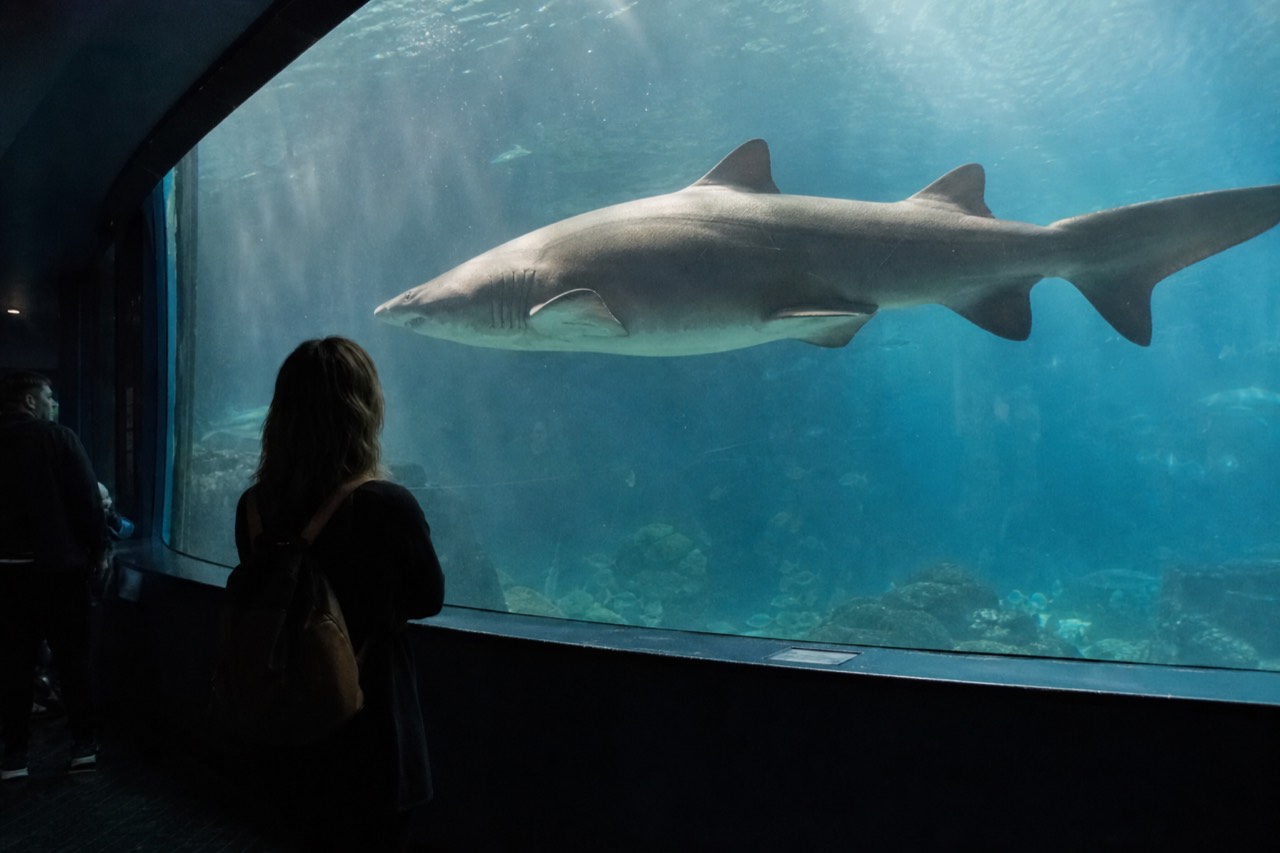
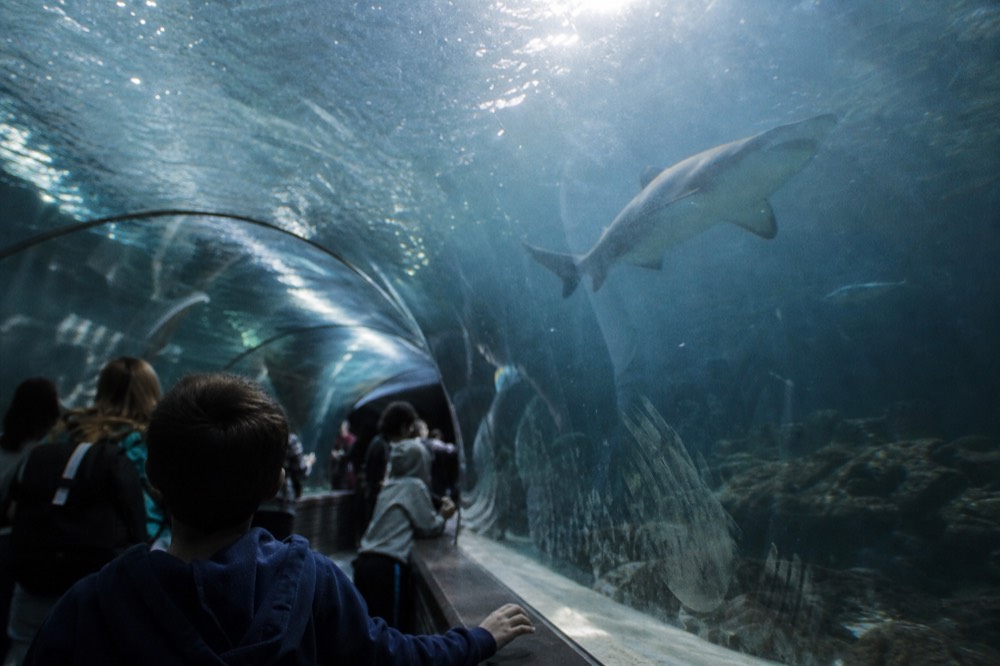
The sharks and rays are housed in themed, named zones, each with published feeding routines that visitors can plan around, but the aquarium publishes no enclosure dimensions of any kind, which means the actual size and scale of every habitat remains unknown; because of that gap, the housing can be described in detail but not scored, and this section does exactly that, zone by zone. The verified zone record lists twelve named areas, and the sharks and rays are spread across several of them: Shark Walk, where a glass floor panel puts you above the Pacific display with five types of shark inches below your feet; the Ocean Tunnel, the walk-through tunnel where eagle rays and sharks pass overhead; Shark Shipwreck, the staged wreck that hosts the Tuesday, Thursday, Saturday and Sunday shark feed at 1:30 p.m.; and Fish Bowl, which shares the ray feed with the Ocean Tunnel on Sunday, Monday, Wednesday and Friday afternoons (checked September 2026).
The operator describes a large shark resting in an underwater cave. That observation alone does not establish good or poor welfare: interpretation depends on species, health and a wider behavioural assessment. Visitors should not diagnose welfare from one resting animal.
What cannot be said is anything numerical. No tank volume, no floor area, no water-volume figure and no enclosure dimension is published for any zone or any animal at the Bangkok site. The widely repeated figures online, such as 10,000 square metres of floor space and five million litres of water, come from a Wikipedia entry and travel sites repeating it, not from the operator. This site's policy is to attribute such numbers if used at all, and for housing questions the honest move is to leave them out entirely, because a number with no primary source is worse than no number when the question is welfare.
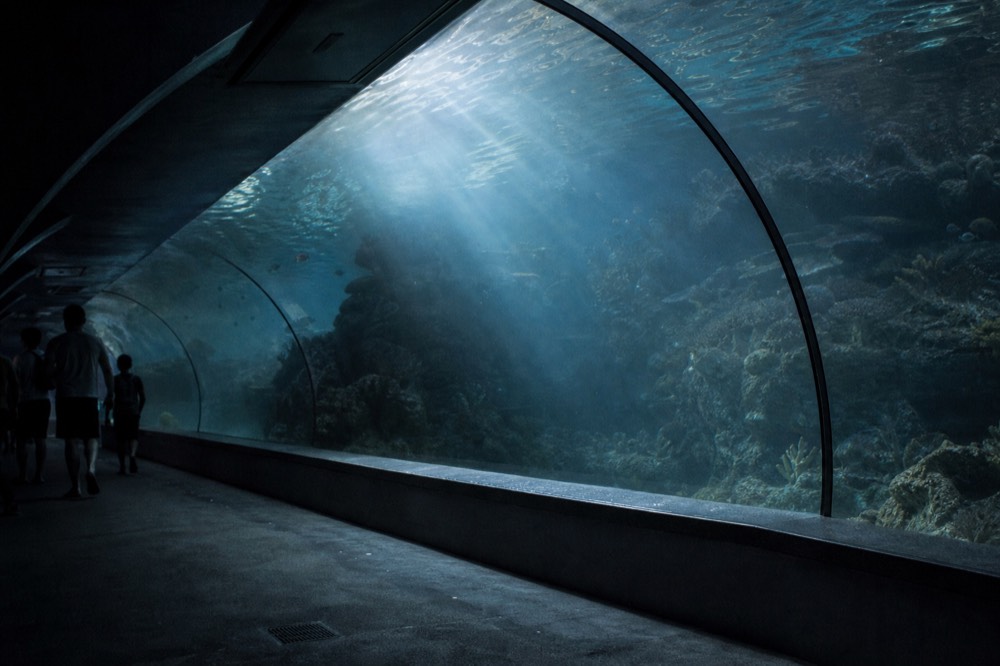
The rays have one documented routine: a feed at 1:30 p.m. on four days of the week at the Ocean Tunnel and Fish Bowl zones, run by staff and free to watch with admission. Verified visitor reports describe the tunnel and the shark displays as the highlights of a visit, with typical visits running from 75 minutes to 3 hours against the operator's own estimate of about 2 hours. None of that measures welfare. It measures that the animals are visible, active at feed times, and central to what the venue sells. For a fuller picture of what lives where, see the zones and animals guide.
What Do Critics Of Mall Aquariums Argue?
Critics of mall aquariums as a class argue that keeping large marine animals in basement tanks, for profit, inside a shopping centre, is inherently compromised whatever the daily care routine looks like, and this section reports that general argument without inventing a Bangkok-specific study. It is important to be precise about attribution here: no specific study, survey or campaign against SEA LIFE Bangkok appears in the verified record, so everything below is the general critique as critics of mall aquariums make it, not findings about this venue. The general critique has three recurring strands, and each deserves a fair statement.
The first strand is space. A shopping-mall basement is a fixed, finite footprint, and the animals that draw the biggest crowds, sharks and rays and penguins, are wide-ranging species in the wild. Critics argue that no basement tank, however well run, is an adequate substitute, and that the commercial incentive to keep charismatic species always pushes against the space they would choose. The counter-position, made by the zoo and aquarium industry generally, is that modern facilities support species in managed populations and that visibility builds public concern for marine life. Neither side of that argument has Bangkok-specific evidence in the verified record.
The second strand is the encounter economy. SEA LIFE Bangkok sells five paid add-on experiences, from a 4D cinema to a glass bottom boat over the coral reef display, all booked at the counter on the day. Critics argue that monetising proximity to animals, particularly touch pools and boat rides over feeding fish, frames animals as entertainment products. The operator's own descriptions cut both ways: the Glass Bottom Boat is pitched as getting up close to sharks, stingrays and fish while staff feed them by hand, and the same activity carries the strictest rules on the site, with life jackets, no selfie sticks, no food or drink, and a signed consent form for the youngest children. For more on what the touch-pool zones actually involve, see can you touch any animals at SEA LIFE Bangkok.
The third strand is transparency. Conservation statements are available, but readers can still ask for independent welfare assessments, veterinary oversight and enclosure information. The existence of conservation reporting does not answer those questions by itself.
How Does It Compare To Thailand's Other Captive-Animal Attractions?
On the verified record, SEA LIFE Bangkok sits in the middle of a Thai captive-animal landscape that includes a permanently closed city zoo, a department-store zoo with a documented welfare controversy, and a replacement national zoo still under construction, and the comparison is one of transparency rather than welfare outcomes. The comparison that matters for context is not with another aquarium's tanks but with the other places a Thailand traveller can see captive animals, and the verified record on those is stark.
Dusit Zoo, Bangkok's historic city zoo, closed to the public for good and has never reopened, confirmed by same-day reporting from a named reputable outlet and by the Zoological Park Organization of Thailand's own site, which lists its zoos and does not include Dusit. The replacement national zoo in Pathum Thani was still a construction project as of a ZPO site visit reported on 14 August 2026, with no confirmed public opening date from the organisation building it. Within the city itself, Pata Zoo, a small zoo on the sixth and seventh floors of a department store, has operated on a reduced schedule since April 20, 2026, according to secondary sources: it is now open only on Fridays, Saturdays, Sundays, and public holidays, from 10:00 a.m. to 6:00 p.m. Check before travelling. Safari World, the full-day outdoor park on the city's northeastern edge, has faced documented international criticism of its treatment of orangutans and elephants, and publishes no admission price at all on any channel it controls.
Against that backdrop, SEA LIFE Bangkok is an indoor, two-hour, fully price-published aquarium in a mall basement with a published feed schedule and published encounter rules. That does not make it ethical, and it does not answer the space critique, but it does mean the venue is more transparent about its commercial basics than several of the animal attractions around it. The honest comparison is between an operator that publishes its prices and its feed times but no welfare data, and operators that publish less, or that carry documented welfare controversies. If you are weighing whether the visit is worthwhile on value grounds rather than purely ethical ones, the SEA LIFE Bangkok review guide covers that question directly.
What Should You Look For On Your Own Visit?
If you choose to visit, observe the exhibits and ask staff about animal care, while recognising that a short visit cannot establish an animal’s welfare or replace an expert assessment. Feed schedules and encounter rules help organise a visit; they are not diagnostic tests.
| What to check | Where and when | What you are looking for |
|---|---|---|
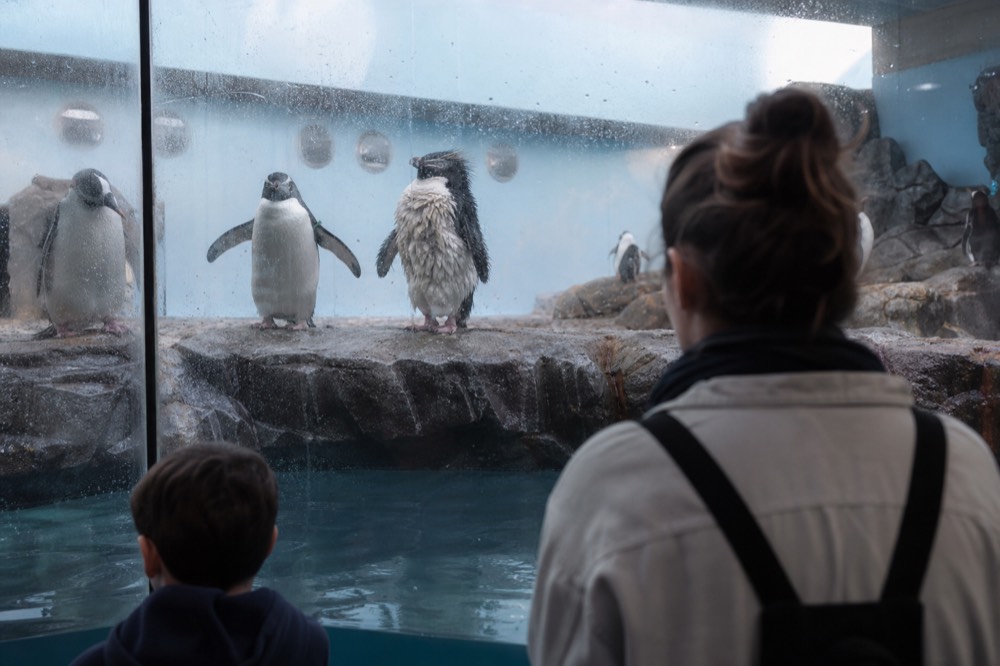
| A scheduled feed | Otters 11:00 a.m. or 3:00 p.m., Jackass penguins 11:30 a.m. or 3:30 p.m., Gentoo penguins 12:30 p.m. or 4:00 p.m., rays or sharks 1:30 p.m. depending on the day (checked September 2026) | Whether animals respond to staff, whether the feed looks routine and calm, and whether staff talk about the animals while they work |
| The shark's resting behaviour | Shark Shipwreck and the Ocean Tunnel | The operator says the 4-metre shark sleeps most of the day in a cave; see whether the animal has that retreat space and uses it |
| Animals between feeds | Any zone, any time | Swimming patterns, visible injuries or skin condition, and whether animals hover at the glass or avoid it |
| The touch-pool rules | Rockpools, and the Beyond the Surface counter at Rockpools | How staff supervise touching, whether there are limits, and how they explain the animals |
| The Glass Bottom Boat rules | Coral Reefs; detailed page lists 10:00–19:00, closed 13:30–14:30; confirm session | Life jackets, the selfie-stick ban and the food ban are published; see whether they are enforced on the day |
| Lighting and sound | Throughout; the operator notes lighting and music vary across the attraction | Whether loud zones have quiet retreats, and how animals near the noisiest displays behave |
Two planning notes make the checklist work better. First, arrive before 11:00 a.m. if you want the fullest feed schedule; the operator's own crowd advice to visit after 2 p.m. quietly costs you the 1:30 p.m. shark or ray feed and the morning otter feed, leaving only the 3:00 p.m. otter, 3:30 p.m. Jackass penguin and 4:00 p.m. Gentoo feeds ahead of you. Second, remember there is no re-entry once you leave, so do the whole circuit in one pass and give the animals time to settle into your presence before you judge them. The operator's own estimate for a visit is about 2 hours, with verified visitor reports running from 75 minutes to 3 hours.
Check the dates and scope of any welfare or conservation document you find. A global programme, a Bangkok-linked project and an independent assessment of a particular enclosure answer different questions. New evidence should change the assessment when it addresses those questions.
The answers below distinguish published conservation statements from unresolved animal-welfare questions. Operator reporting, an independent audit and a visitor’s impressions should not be treated as interchangeable evidence.
Common Questions About Animal Welfare At SEA LIFE Bangkok
Is SEA LIFE Bangkok Ethical?
The reviewed evidence does not settle that verdict. The operator publishes conservation statements, but those are not an independent assessment of welfare inside the Bangkok exhibits.
Does SEA LIFE Bangkok run a conservation or breeding programme?
The operator describes Bangkok’s Pro Reef Project. Brand-wide breeding claims should not be read as proof of Bangkok-specific breeding results without a local record.
How big are the tanks at SEA LIFE Bangkok?
The operator publishes no enclosure dimensions, no tank volumes and no floor-area figure. The numbers in circulation online come from an uncited encyclopedia entry and sites repeating it, not from the operator. The only quantitative line the operator publishes is "hundreds of marine species on display".
Are the animal encounters at SEA LIFE Bangkok cruel?
The reviewed sources do not settle that question. Published visitor-safety rules explain participation, but they are not an independent assessment of animal welfare or touch-pool supervision.
What can I check myself on a visit?
Watch a scheduled feed and see whether animals respond calmly to staff, watch the 4-metre shark's resting behaviour at Shark Shipwreck, observe animals between feeds for swimming patterns and skin condition, and check whether the published encounter rules are enforced on the day. Arriving before 11:00 a.m. gives you the fullest feed schedule to judge from.
Is SEA LIFE Bangkok better than Thailand's zoos on welfare?
There is no evidence to rank them. What the record does show is that SEA LIFE publishes its prices and feed schedule, while Safari World publishes no admission price, Pata Zoo carries a documented unresolved welfare controversy, and Dusit Zoo closed permanently in 2018. Transparency about commercial basics is not a welfare record, but the comparison is real.
Choose Your Visit
Decided to visit after weighing the evidence? Check your date and cancellation terms before making the aquarium part of your day.
Aquarium admission at Siam Paragon. Special activities and transfers not included. Valid one day; confirm selected starting time. Cancellation up to 24 hours before the visit. Ages 2–15 require a paying adult. No re-entry.
Compare Options And Tailor Your Choice
Decide whether to visit before comparing sellers. Neither admission option provides an independent welfare certification; Viator admission is non-refundable.
Initial recommendation: SEA LIFE Admission. No preferences selected.
- SEA LIFE Admission: Aquarium admission at Siam Paragon. Special activities and transfers not included. Valid one day; confirm selected starting time. Cancellation up to 24 hours before the visit. Ages 2–15 require a paying adult. No re-entry.
- SEA LIFE Admission On Viator: Select Sea Life Admission. Non-refundable. Confirm the ticket option before paying. Hotel transfers and special activities are excluded.